

Overview of the project
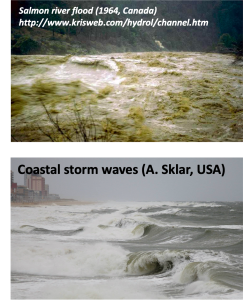
All geophysical water flows are multi-phase flows, most of the time turbulent. This is the case for river and coastal flows, where sediments on an erodible bottom are transported in response to hydrodynamic forces with various small-scale processes. Understanding these sediment transport processes in turbulent flows is essential to predict sediment transport, and anticipate the long-term impacts of the multiplication of extreme events on rivers and coastal systems. Therefore, many attentions have been directed towards turbulence resolving two- phase flow simulations approaches, leading to significant advances in sediment transport modelling, in a will to tackle the challenge of understanding and accounting for the small- scale interactions between the flow turbulence and the dispersed particles. However, the validity of these models is constrained by our inability to provide high-resolution sediment flux (as a local product of the dispersed particles phase velocity and volume fraction) measurements in dilute and dense turbulent two-phase flows. Recently, only hydroacoustic techniques involving coherent Doppler sonars have offered means to resolve fluxes as well as second order turbulence statistics for the dispersed phase in dilute and dense flow conditions, and further suggest their potential to concurrently follow the fluid phase using the scattering properties of the turbulence itself, through the presence of turbulent microstructures formed by passive additive quantities.
RUPTURE ( HydRoacoUstic metrology of two-Phase TURbulent flows for sEdiment transport applications ) project will improve our ability to understand small-scale two-phase turbulent sediment transport processes by developing a novel methodology for two-phase hydroacoustic inversion in dilute to dense turbulent flows.
Project environment :
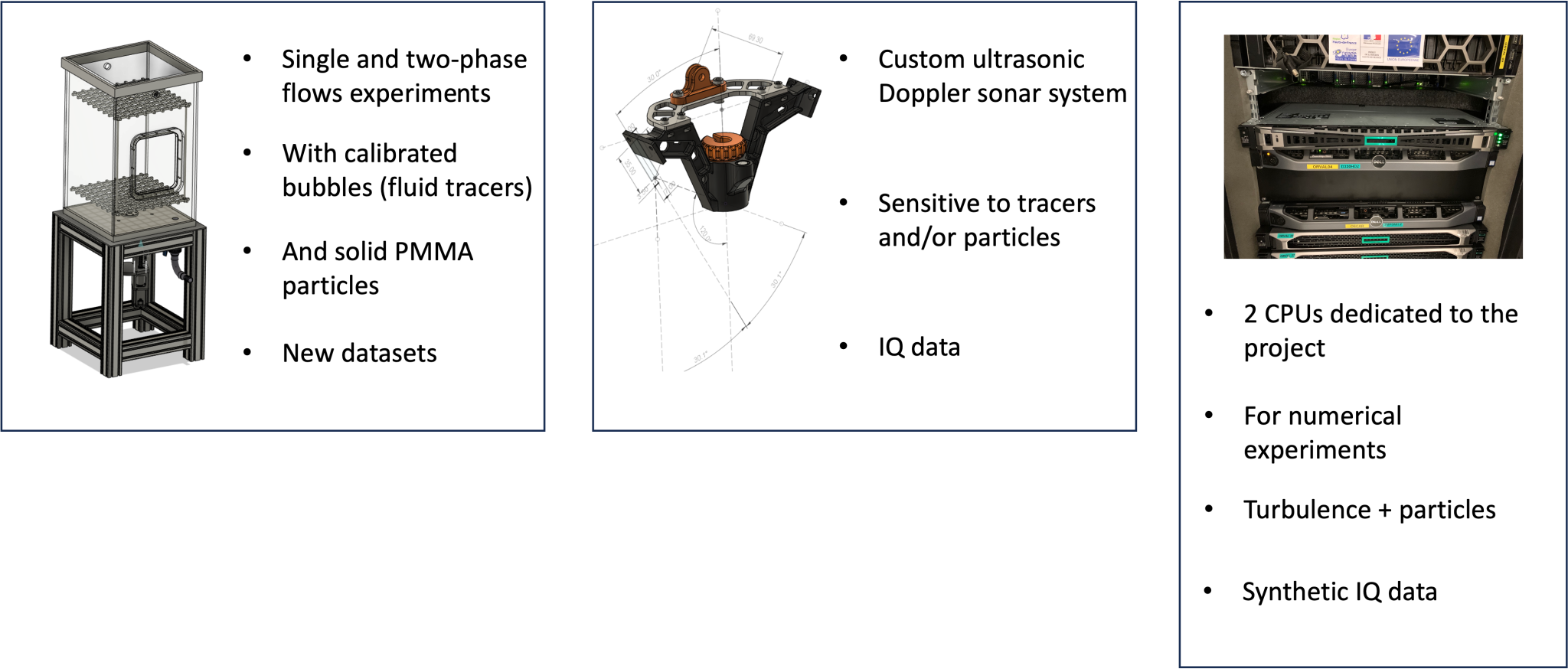
- An experimental facility : a tank equipped with an oscillating grid and a micro-air bubbles generator to generate isotropic turbulent flows in single and two-phase flow conditions. This equipment has been acquired in the frame of the BQR OGI project (2023)
- A UB-Lab 2C (UBERTONE) : This system has been designed to send short pulses that are further backscattered by inhomogeneities on its path (here, particles and/or fluid tracers such as air-bubbles). This produces an echo that is recoreded by multiple receivers. The amplitude and phase of the echos is then used to produce colocated measurement profiles of velocity and concentration, at high spatial (~1mm) and temporal (~10ms) resolutions, hence its capability to return time-resolved particle flux profiles
- A cluster node : Bound to CALCULCO cluster machine, this node equipped with 2 CPU EPYC 9174F will allow to reproduce the experiments carried out in the frame of WP1 numerically (digital twin of the OGI tank).